Key takeaways
- TELC B2 speaking lasts 15 minutes with 20 minutes of silent preparation, while Goethe B2 speaking comprises two parts totaling approximately 8 minutes per candidate.
- TELC uses a standardized grid emphasizing task completion and interaction management, while Goethe weights grammatical range and lexical precision more heavily in its dual-examiner assessment.
- TELC conducts speaking exams as pair examinations, reducing examiner-led anxiety but requiring strong turn-taking skills; Goethe pairs candidates for Part 2 only.
- Assessment criteria differ fundamentally: TELC evaluates Ausdrucksfähigkeit, Aufgabenbewältigung, formale Richtigkeit, and Aussprache with explicit descriptors, whereas Goethe assesses production and interaction competencies under CEFR frameworks.
- Choosing between exams depends on whether you excel at collaborative problem-solving (TELC) or structured presentation with precise grammar (Goethe).
The TELC B2 exam speaking section and Goethe B2 exam speaking section test the same proficiency level. But they use different task structures, timing models, and assessment priorities. TELC runs a 15-minute paired conversation across three distinct tasks. Goethe splits its speaking module into a shorter presentation-plus-discussion format. Goethe weights grammatical accuracy more heavily.
This comparison is for intermediate learners preparing for B2 certification in 2026. It helps job seekers who need proof of German proficiency for employment in German-speaking countries. It also helps university applicants choosing between the two most recognized exam boards in Europe.
What does the decision matrix tell you before you book?
| Feature | TELC B2 Speaking | Goethe B2 Speaking |
|---|---|---|
| Total duration | 15 minutes | ~8 minutes per candidate |
| Preparation time | 20 minutes (silent, no aids) | ~15 minutes (varies by center) |
| Candidate pairing | Paired throughout | Paired in Part 2 only |
| Number of tasks | 3 (introduction, discussion, problem-solving) | 2 (presentation, joint discussion) |
| Examiner role | Passive observer; candidates drive interaction | Active in Part 1; moderates Part 2 |
| Assessment focus | Task completion, interaction management, formal accuracy, pronunciation | Grammatical range, lexical precision, production & interaction under CEFR |
I've prepared candidates for both exams since 2022. The table above clarifies the single biggest strategic difference. TELC rewards your ability to manage a conversation with a peer under time pressure. Goethe rewards your ability to deliver structured monologue content with minimal errors. If you freeze when a partner interrupts you mid-sentence, TELC will feel harder. If you struggle to sustain a two-minute solo presentation without filler words, Goethe will expose that weakness faster.
Choose TELC if you learn languages through conversation. Choose it if you feel more confident bouncing ideas off another person. Choose Goethe if you prefer rehearsed, examiner-led formats. Choose it if you want to control your speaking time and showcase prepared vocabulary. For realistic practice under exam conditions, German Mock Exams offers complete TELC and Goethe B2 mock tests with audio files. You can simulate both formats before committing to a test date.
How do TELC B2 speaking tasks unfold in the exam room?
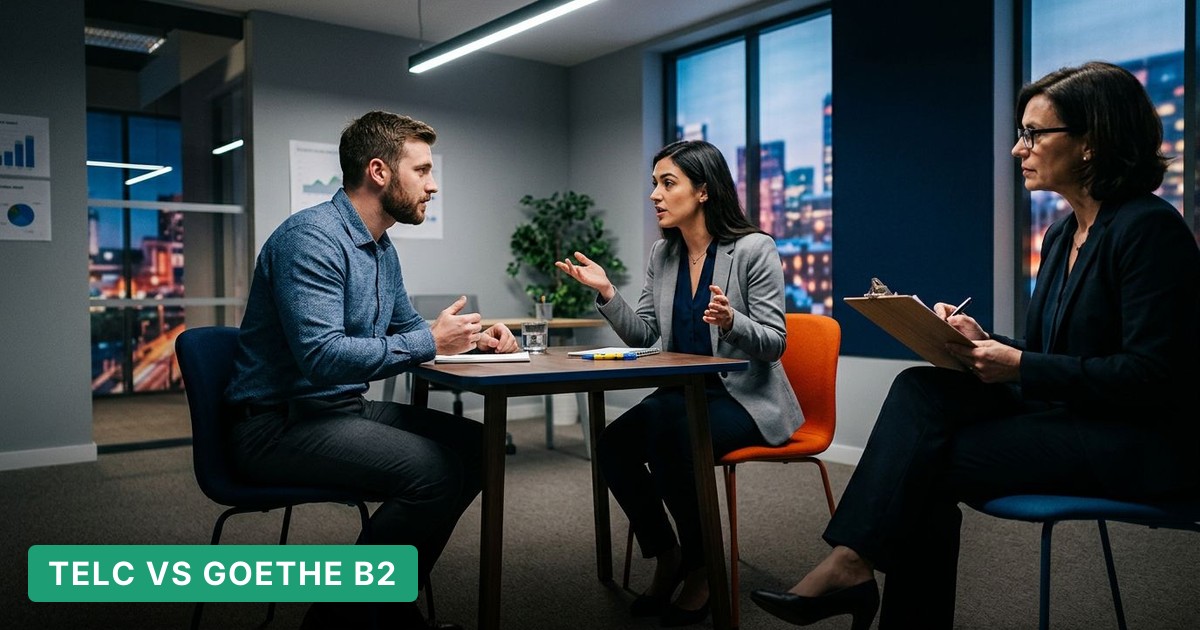
TELC structures its speaking module as three consecutive tasks with no break between them. You and your partner sit across from two examiners who score silently throughout. The 20-minute preparation phase happens in a separate room. You receive printed task sheets there. You may not use dictionaries, phones, or grammar notes during this time.
Part 1: Sich vorstellen und Gesprächspartner/in kennenlernen (approximately 3 minutes total). You introduce yourself briefly—name, background, why you're taking the exam. Then you ask your partner two or three questions about their experience learning German or their plans after certification. This section feels conversational but examiners score how naturally you initiate and respond to questions. Weak candidates recite memorized scripts without listening to their partner's answers. Strong candidates build follow-up questions based on what they just heard.
Part 2: Diskussion/Argumentation über ein Thema (approximately 5 minutes). Both candidates receive the same discussion prompt during preparation. A typical 2026 TELC B2 prompt might read: "Sollten Arbeitgeber das Recht haben, Mitarbeiter außerhalb der Arbeitszeit per E-Mail zu kontaktieren? Diskutieren Sie Vor- und Nachteile." You and your partner must present opposing viewpoints. You must defend your position with examples. You must respond to counterarguments. TELC expects you to use discourse markers (meiner Meinung nach, im Gegensatz dazu, das sehe ich anders). You must manage turn-taking without examiner prompts. If your partner dominates the conversation, you lose points for Aufgabenbewältigung. This happens even if your grammar is flawless.
Part 3: Problemlösung (approximately 7 minutes). You receive a scenario requiring joint planning. Examples include organizing a company event, resolving a workplace conflict, or coordinating a community project. The task sheet lists four or five bullet points you must address. These cover budget, timeline, responsibilities, and potential obstacles. Success here depends on collaborative negotiation. You must propose ideas. You must agree or disagree politely. You must reach consensus within the time limit. Examiners penalize candidates who simply list ideas without engaging their partner's suggestions.
TELC's standardized assessment grid weights Aufgabenbewältigung (task completion) and interaction skills heavily in Parts 2 and 3. A candidate who completes all bullet points with minimal grammar errors but poor turn-taking will score lower. This is true even compared to a candidate with occasional article mistakes who drives the conversation forward effectively. This weighting explains why many grammar-focused learners struggle with TELC despite strong written scores. The exam punishes passive participation even when your sentences are technically correct.
What makes Goethe B2 Mündliche Prüfung structurally different?
Goethe B2 speaking consists of two parts: a solo presentation (Part 1) followed by a paired discussion (Part 2). The entire module runs shorter than TELC—approximately 8 minutes per candidate. But the density of assessment criteria per minute is higher.
Part 1: Produktion (approximately 3 minutes per candidate). You receive four presentation topics during the preparation phase and choose one. A representative Goethe B2 prompt from recent exam cycles: "Die Rolle von sozialen Medien in der modernen Demokratie. Beschreiben Sie die Situation in Ihrem Heimatland, berichten Sie von Ihren Erfahrungen, und äußern Sie Ihre Meinung." You speak uninterrupted for roughly 90 seconds. Then the examiner asks two or three follow-up questions to probe depth. Unlike TELC, your partner does not interact during your presentation. They present separately on a different topic.
This format rewards candidates who can sustain a coherent monologue with varied syntax. Goethe examiners score grammatical range explicitly. Using only Präsens and Perfekt limits your score ceiling. Demonstrating Konjunktiv II, Plusquamperfekt, and subordinate clauses with obwohl, indem, or sodass signals B2 competence. Lexical precision matters more here than in TELC. Choosing beeinflussen over machen or Herausforderung over Problem lifts your score. Task completion alone cannot do this.
Part 2: Interaktion (approximately 5 minutes total). You and your partner discuss a shared topic related to one of the presentations. The examiner moderates lightly. The examiner steers the conversation if it stalls but otherwise lets you negotiate meaning together. A typical Goethe Part 2 task: "Diskutieren Sie, wie Schulen Medienkompetenz fördern sollten. Planen Sie gemeinsam ein Projekt für Schüler." The structure resembles TELC Part 3 but runs shorter and expects faster argumentation.
Goethe assesses production and interaction competencies under CEFR descriptors. This means examiners evaluate not just whether you completed the task. They assess how accurately and fluently you expressed complex ideas. A candidate who uses advanced grammar with occasional pronunciation slips will outscore a candidate with perfect pronunciation but repetitive sentence structures. This weighting reverses TELC's priorities. Goethe tolerates minor task incompletion if your language demonstrates clear B2 range. TELC penalizes incomplete tasks even when your grammar shines.
Why do assessment criteria weightings change your preparation strategy?
I've watched candidates pass TELC B2 speaking with scores above 85% while failing Goethe B2 speaking on the same day. I've seen the reverse happen too. The reason is not luck. It's criteria alignment with learner strengths.
TELC's Aufgabenbewältigung criterion asks: Did you address all parts of the task? Did you manage the conversation so both partners contributed equally? Did you reach a conclusion in Part 3? These are behavioral skills, not purely linguistic ones. A candidate with B1+ grammar who practices active listening will often pass TELC. The same is true if they ask clarifying questions and build on their partner's ideas. The same candidate might struggle with Goethe Part 1. Sustaining a solo presentation requires different cognitive load. You cannot rely on your partner's input to fill gaps.
Goethe's emphasis on grammatical range and lexical precision means your preparation must include explicit grammar drills. Practice Konjunktiv II for polite disagreement. Use je…desto constructions for comparisons. Vary your verb placement with inversion. TELC examiners notice these features but do not weight them as heavily. They only matter if their absence prevents task completion. Goethe examiners score them directly under the "range" descriptor. A candidate who uses only simple sentences hits a score ceiling around 60–70%. This happens even if they are fluent and task-complete.
One candidate achieved a 91% score in the TELC B2 speaking section by focusing on interaction management and task completion over grammar perfection. That same strategy would not guarantee Goethe success unless paired with targeted grammar expansion. Conversely, candidates who excel at Goethe often find TELC's partner dependency frustrating. If your partner speaks slowly or monopolizes Part 2, your individual brilliance cannot fully compensate.
For structured practice that mirrors both exam formats, German Mock Exams provides complete B2 speaking scenarios with detailed answer keys. This allows you to identify which criteria set aligns with your current skill profile before booking an exam date.
How does paired vs solo interaction affect exam-day anxiety?
TELC's fully paired format distributes cognitive load differently than Goethe's hybrid model. When you share the speaking burden with a partner for all 15 minutes, you gain recovery time between your turns. Your partner's contributions give you seconds to plan your next sentence. This structure benefits candidates who process language better in dialogue than monologue. However, it introduces a variable you cannot control: your partner's proficiency and collaboration style.
I've seen TELC candidates paired with partners who barely spoke. This forced them to carry the entire conversation. Examiners score you individually, so a silent partner does not directly lower your grade. But managing that silence while still completing tasks requires advanced pragmatic skills. If your partner interrupts constantly or dominates Part 2, you must assertively reclaim speaking time. Use phrases like Darf ich kurz etwas hinzufügen? or Ich möchte noch einen anderen Aspekt erwähnen. Passive candidates lose Aufgabenbewältigung points even when their grammar is strong.
Goethe's Part 1 eliminates partner variability entirely. You present alone. The examiner listens. Your score depends solely on your output. This format suits candidates who experience social anxiety in peer conversation. It also suits those who prefer rehearsed content over improvisation. The tradeoff: you must sustain fluency without external prompts. If you blank mid-sentence during a TELC task, your partner might ask a question that gets you back on track. In Goethe Part 1, silence is entirely your responsibility to fill.
Part 2 of Goethe introduces pairing but runs shorter. It has lighter examiner moderation than TELC. The examiner may jump in if the discussion stalls. Some candidates find this reassuring. Others find it disruptive. TELC examiners remain almost entirely silent unless a technical issue arises. So you and your partner own the interaction fully.
If you have strong collaborative skills and feel energized by conversation, TELC's format will likely feel more natural. If you prefer controlled, examiner-led structures where you can showcase prepared material, Goethe's shorter, presentation-heavy format plays to that strength. Understanding exam board differences at the B1 level is helpful here. Our guide to why exam board matters more than course platform covers this. The same principle applies at B2: format shapes performance as much as proficiency does.
What do real prompts reveal about tone and complexity?
Comparing actual task prompts shows how TELC and Goethe approach the same CEFR level. They use different rhetorical expectations.
TELC B2 Part 3 sample prompt: "Sie und Ihr/e Gesprächspartner/in arbeiten in einer Firma. Ihr Chef möchte ein Gesundheitsprogramm für Mitarbeiter einführen. Planen Sie gemeinsam: Welche Aktivitäten sollen angeboten werden? Wie motiviert man Kollegen zur Teilnahme? Welche Kosten entstehen? Wer organisiert das Programm?"
This prompt lists concrete sub-tasks. It expects you to negotiate each one with your partner. The language required is functional and transactional. You propose. You agree. You assign responsibilities. You can pass with relatively simple grammar if you complete all bullet points and manage turn-taking well. The tone is workplace-practical, not abstract.
Goethe B2 Part 1 sample prompt: "Gesunde Ernährung im Alltag. Beschreiben Sie, wie Menschen in Ihrem Heimatland sich ernähren. Berichten Sie von Ihren eigenen Erfahrungen. Äußern Sie Ihre Meinung zu den Vor- und Nachteilen von vegetarischer Ernährung."
This prompt demands a more reflective, essayistic response. You must shift between description (Heimatland), personal narrative (Erfahrungen), and opinion with supporting reasoning (Vor- und Nachteile). The grammar load is higher. You need past tenses for narrative. You need conditional or subjunctive for hypotheticals. You need cohesive devices to link the three sections smoothly. The tone is more formal and analytical than TELC's problem-solving style.
These differences are not arbitrary. TELC designs tasks around real-world communication scenarios. These include planning, negotiating, and problem-solving. This aligns with its recognition by employers and immigration authorities across Europe. Goethe designs tasks that test your ability to construct extended discourse on abstract topics. This aligns with its academic and cultural mission as an institute promoting German language and culture globally.
Neither approach is inherently harder, but they reward different skill sets. If you trained primarily through conversation exchange or workplace German, TELC's prompts will feel more familiar. If you studied through textbook chapters on societal issues and practiced essay writing, Goethe's prompts align better with that preparation.
Which exam should you choose based on your learning profile?
Your decision should rest on three factors: your natural communication style, your grammar confidence, and the recognition requirements of your target institution or employer.
Choose TELC if: you learn best through dialogue. Choose it if you feel comfortable thinking on your feet in conversation. Choose it if you can manage turn-taking assertively. TELC suits candidates who may have grammar gaps but strong pragmatic skills. These include knowing when to agree, disagree, propose alternatives, and build consensus. The 15-minute duration and three-task structure also give you more opportunities to recover from a weak start. If Part 1 goes poorly, you can still demonstrate competence in Parts 2 and 3.
Choose Goethe if: you excel at structured presentations. Choose it if you have invested heavily in grammar accuracy. Choose it if you prefer shorter, examiner-moderated formats. Goethe rewards candidates who can deliver polished monologues with varied syntax and precise vocabulary. The shorter total time (8 minutes per candidate) means less endurance pressure. But it also means higher density of assessment per minute. If you blank during your 3-minute presentation, you have less buffer time to compensate than in TELC's 15-minute conversation.
Recognition equivalence: Both exams are accepted by German immigration authorities for visa purposes. Both meet CEFR B2 standards for university admission and professional licensing. TELC is recognized by employers and educational institutions across Europe. Goethe operates 157 institutes in 98 countries with global recognition. Check your specific institution's requirements. Some universities list both. Some prefer one. A few accept only Goethe for certain programs.
Cost and availability: TELC exam fees typically run €10–30 lower than Goethe in most German cities as of 2026. Test dates are often more frequent at adult education centers (Volkshochschulen). Goethe exam slots fill faster in major cities but offer more international test centers for candidates outside Germany.
Preparation resources: TELC publishes official sample tests with detailed scoring rubrics. This makes self-study more transparent. Goethe provides model exams but with less granular criteria explanation. So many candidates invest in prep courses. For self-directed practice, German Mock Exams delivers format-accurate speaking scenarios for both TELC and Goethe B2 exams. It includes audio files and answer keys. This eliminates the guesswork around task expectations.
If you are still deciding between exam boards at earlier levels, the principles outlined in our A2 exam course comparison apply here. Format alignment matters more than brand reputation when your goal is passing efficiently.
Final recommendation: match the exam to your strongest skills, not the one your friend passed
I recommend choosing the exam that rewards what you already do well. Don't force yourself into a format that exposes your weakest skills. If you are a natural conversationalist who thinks best in dialogue, TELC's paired structure will feel less artificial. It will allow you to demonstrate competence even with imperfect grammar. If you are a careful planner who prefers rehearsed content and precise language, Goethe's presentation-plus-discussion format will showcase your strengths more effectively.
Do not choose based solely on which exam your classmates are taking. Do not choose based on which your teacher prefers. The assessment criteria differences are real and measurable. TELC weights task completion and interaction management more heavily. Goethe prioritizes grammatical range and lexical precision. A candidate who scores 80% on TELC might score 65% on Goethe with the same proficiency level. This happens simply because the exams measure different dimensions of B2 competence.
Run a diagnostic. Record yourself completing one TELC Part 3 task and one Goethe Part 1 presentation. Use official sample prompts. Listen back and score yourself honestly using the published criteria from each board. Whichever format lets you demonstrate more B2 descriptors naturally is the exam you should book. Then practice exclusively in that format for the final four weeks before your test date. Mixing formats during peak preparation dilutes your strategic advantage.
For candidates who need flexible, format-specific practice without enrolling in a full course, German Mock Exams provides instant-download B2 speaking materials. These are compatible with both TELC and Goethe assessment grids. You can train precisely for the exam you choose rather than hoping generic B2 practice will transfer.
Frequently Asked Questions
How does the format of the TELC B2 speaking exam differ from the Goethe B2 speaking exam?
What assessment criteria are used in the TELC B2 and Goethe B2 speaking exams?
How is candidate pairing handled in the TELC B2 and Goethe B2 speaking exams?
What is the preparation time for the TELC B2 and Goethe B2 speaking exams?
Which exam is better for candidates who excel at collaborative problem-solving versus structured presentations?
Further Reading & Resources
- Everything you need to know about the B2 TELC German exam
- TELC B2 share your experiences with oral and written parts - Reddit
- telc B2 Exam Explained | Structure, Points, Passing Criteria & Modules
- Telc B2 Exam Structure and Scoring | PDF | Qualifications - Scribd
- From Zero to TELC B2: The Ultimate 12-Week - DeutschExam.ai
- Telc B2 German | Telc Prüfung - Apps on Google Play
- telc Deutsch B2 - Demonstrate your language skills at level B2
Leave a comment