Key takeaways
- Start mock exams for german language b1 exam preparation 6–8 weeks before your test date to allow time for diagnostic feedback and targeted improvement.
- Simulate real exam conditions by eliminating dictionaries, setting strict timers, and choosing a quiet environment to reveal time-management weaknesses early.
- The Goethe-Zertifikat B1 exam consists of four parts: Reading (65 minutes), Listening (40 minutes), Writing (60 minutes), and Speaking (15 minutes pair examination or 10 minutes individual), requiring strategic time allocation per task.
- To pass the Goethe-Zertifikat B1, candidates must achieve at least 60% of the maximum points in both the written examination and the oral examination, making self-scoring essential to track readiness.
- A two-week mock exam schedule should progress from one diagnostic test to three full simulations, with error analysis sessions between each attempt.
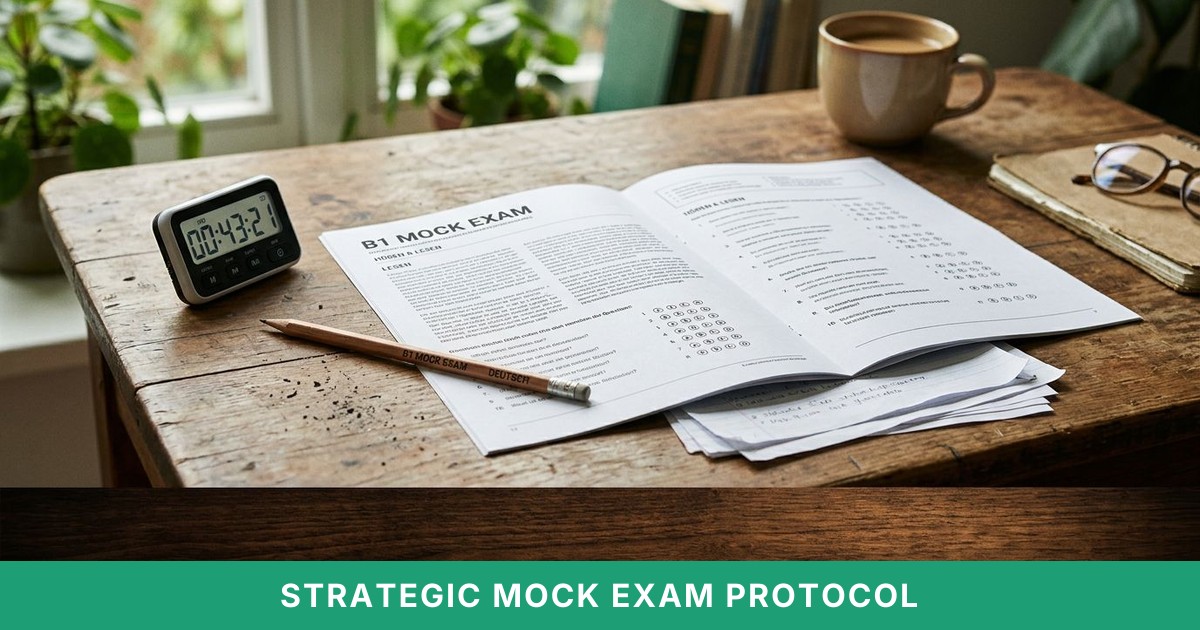
Most learners treat mock exams for german language b1 exam preparation like optional homework—they download a test, skim through it casually with a coffee, check a few answers, and assume they're ready. That approach wastes the single most predictive tool you have. A properly executed mock exam reveals not just what you don't know, but how you collapse under time pressure, where your reading stamina fails at minute 50, and which question types drain your cognitive budget before you reach the writing section.
This guide is for students, expats, and foreigners preparing for Goethe or TELC B1 exams who need a structured protocol to turn practice tests into diagnostic instruments, not just revision exercises.
When should you start taking B1 practice tests?
I recommend beginning mock exams for german language b1 exam preparation exactly 6–8 weeks before your exam date. Earlier than that, you're testing knowledge you haven't consolidated yet; later, you won't have time to address the gaps the tests reveal.
Here's why this window matters. The CEFR B1 level is defined as an independent user who can understand the main points of clear standard input on familiar matters and produce simple connected text on topics of personal interest. That independence requires automaticity—you need grammar patterns and vocabulary retrieval to happen without conscious effort. Mock exams expose where you're still translating in your head or pausing to recall verb conjugations. Six weeks gives you time to drill those specific weaknesses before the real test.
Your first mock exam should be a diagnostic baseline. Take it in week one of your preparation window, score it honestly, and use the results to build a targeted study plan for weeks 2–5. Reserve weeks 6–8 for three additional full simulations under progressively stricter conditions. This rhythm—diagnose, improve, simulate—prevents the common mistake of taking 15 practice tests without ever analyzing why you're making the same errors.
If you're using German Mock Exams' complete B1 practice materials with audio files, start with the free sample test as your diagnostic, then schedule the remaining four tests at two-week intervals during your preparation phase.
How do you create real B1 exam simulation conditions at home?
Authentic exam conditions aren't about recreating the physical room—they're about replicating the cognitive load and time constraints that cause most failures. Here's the protocol I use and recommend to every learner.
Environment setup:
- Choose a quiet room where you won't be interrupted for 3 hours (the full written exam duration for Goethe B1).
- Remove all dictionaries, grammar references, and translation apps from the room. No exceptions.
- Use a simple analog timer or phone timer placed face-down so you can't constantly check it.
- Print the exam materials if possible—scrolling through PDFs introduces a different reading fatigue than paper.
Timing discipline: The Goethe-Zertifikat B1 exam consists of four parts: Reading (65 minutes), Listening (40 minutes), Writing (60 minutes), and Speaking (15 minutes pair examination or 10 minutes individual). Set separate timers for each section and stop immediately when time expires, even mid-sentence. This is critical. Most learners give themselves "just two more minutes" during practice, then panic when the real proctor collects their papers. The discomfort of leaving questions blank in practice is exactly what you need to experience now, not on exam day.
Audio section realism: For the Listening section, play the audio files exactly twice (the standard in both Goethe and TELC formats). Do not pause between listenings to review your answers. Do not replay difficult sections. The audio controls your pace—this is where many learners discover they can't process spoken German at native speed while simultaneously reading questions and writing answers. That realization is the entire point of the simulation.
If you skip these conditions and take "relaxed" practice tests, you're training for an exam that doesn't exist. The real B1 test measures how well you perform under constraint, not how well you understand German when you have unlimited time and resources.
What are the four B1 sections and how should you allocate time within each?
Understanding the internal time structure of each section prevents the catastrophic mistake of spending 30 minutes on a 15-point reading task and rushing through a 25-point writing prompt. Here's the breakdown I teach based on the Goethe B1 format (TELC follows similar patterns).
Reading (Lesen) — 65 minutes total
- Teil 1 (Correspondence): 10 minutes for 5 items — matching short messages to situations
- Teil 2 (Newspaper/blog articles): 20 minutes for 5 items — identifying opinions and main ideas
- Teil 3 (Announcements/ads): 15 minutes for 10 items — scanning for specific details
- Teil 4 (Opinions on a topic): 15 minutes for 5 items — matching statements to positions
- Buffer: 5 minutes to transfer answers and check
The common mistake: spending 25 minutes on Teil 1 because you're nervous and want to "get it perfect." Those are the easiest points—grab them quickly and invest your cognitive energy in Teil 2 and Teil 4, where inference and opinion-matching require deeper processing.
Listening (Hören) — 40 minutes total
- Teil 1 (Telephone/announcements): ~8 minutes for 5 items — listening for specific information
- Teil 2 (Radio interview): ~10 minutes for 5 items — understanding main ideas and details
- Teil 3 (Everyday conversations): ~7 minutes for 5 items — identifying speakers' intentions
- Teil 4 (Opinions/discussions): ~10 minutes for 5 items — matching speakers to viewpoints
- Transfer time: 5 minutes to copy answers to answer sheet
You control nothing here except your note-taking strategy. Practice writing minimal cues (single words, not full sentences) during the first listening, then use the second listening to confirm and complete. Many learners write nothing during the first play and try to hold everything in memory—that approach fails in Teil 2 and Teil 4 when you're tracking multiple speakers.
Writing (Schreiben) — 60 minutes total
- Teil 1 (Formal letter/email): 25 minutes — 4 content points, ~80 words
- Teil 2 (Discussion forum post): 25 minutes — responding to a topic, ~80 words
- Buffer: 10 minutes to proofread both texts
The killer mistake: writing 150-word responses because you want to "show off" your German. You earn zero extra points for length and you burn time you need for proofreading. To pass the Goethe-Zertifikat B1, candidates must achieve at least 60% of the maximum points in both the written examination and the oral examination—a grammatically clean 80-word text scores higher than a 150-word text riddled with case errors and verb agreement mistakes.
Speaking (Sprechen) — 15 minutes (pair) or 10 minutes (individual)
- Teil 1 (Planning a joint activity): ~3 minutes
- Teil 2 (Presenting a topic): ~3 minutes per candidate
- Teil 3 (Responding to your partner's topic): ~2 minutes per candidate
This section doesn't appear in your mock exam materials with audio, but you can simulate it by recording yourself responding to prompts and timing your responses. The critical insight from timed practice: most learners speak too fast and run out of content after 90 seconds. You need to develop pacing strategies—adding examples, asking rhetorical questions, restating your main point—to fill the time without repetition.
How do you score your own B1 mock exam without a teacher?
Self-scoring is where most learners give up or, worse, inflate their scores and develop false confidence. Here's the framework I use to score objectively.
Reading and Listening: Straightforward. Each section has an answer key. Count correct answers, calculate your percentage, and compare against the 60% passing threshold. If you scored 70% on Reading but only 50% on Listening, you know exactly where to focus your next two weeks of study.
Writing: This is harder. Use this rubric based on the official Goethe criteria:
- Content (4 points per task): Did you address all required points? For Teil 1, check that you covered all four bullet points in the prompt. Missing one point = automatic deduction.
- Communicative design (4 points): Is your text organized logically? Does it have a clear opening and closing? Are your paragraphs coherent?
- Language accuracy (4 points): Count your errors. Fewer than 5 errors = 4 points. 5–10 errors = 3 points. 11–15 errors = 2 points. More than 15 errors = 1 point or less.
- Vocabulary (3 points): Did you use B1-level vocabulary appropriately? Repeating the same 10 words = low score. Varied expressions related to the topic = full points.
Be brutal with error counting. Every wrong article, every incorrect verb ending, every missing comma in a subordinate clause counts. If you're generous during practice, you'll be shocked on exam day when the examiner isn't.
Speaking: Record yourself and listen back. Time each response. Ask yourself: Did I speak for the required duration? Did I stay on topic? Did I use complete sentences or just fragments? Did I make multiple grammar errors that would confuse a listener? Score conservatively—if you hesitated for more than 3 seconds mid-sentence, that's a fluency issue.
For comprehensive scoring, compare your performance against the benchmarks in how TELC and GOETHE mock exams transform language learning outcomes.
What common mistakes do timed practice tests reveal?
Mock exams expose failure patterns you'd never notice in untimed study. Here are the five I see most often.
Mistake 1: Reading every word in the Reading section. You have 65 minutes to process roughly 1,200 words of German text. If you read every sentence carefully, you'll finish Teil 1 and Teil 2 and run out of time before Teil 3. Timed practice forces you to develop scanning skills—reading questions first, then hunting for keywords in the text. This feels uncomfortable initially, but it's the only way to finish.
Mistake 2: Writing your Schreiben tasks in English first, then translating. This doubles your cognitive load and introduces unnatural phrasing. Timed practice reveals how much time you waste on this approach—usually 10–15 minutes you don't have. Train yourself to compose directly in German, even if your first draft feels clumsy.
Mistake 3: Ignoring the audio section until the last week. Most students fail the Goethe B1 exam due to avoidable mistakes such as ignoring the speaking section, memorizing vocabulary without context, and poor time management. The Listening section requires a different kind of stamina—sustained concentration while processing spoken German at native speed. If you only practice reading and writing, you'll hit the audio section already mentally fatigued and your scores will collapse.
Mistake 4: Not tracking your error patterns. Taking three mock exams without analyzing your mistakes is like running the same failed experiment three times. After each test, create a simple spreadsheet: What question type did I miss? What grammar point caused the error? What vocabulary gap prevented me from understanding the text? If you miss subjunctive II questions in three consecutive tests, that's your study priority for the next week.
Mistake 5: Skipping the Speaking section because "I'll just wing it on exam day." Speaking is the only section where you can't improve through passive study. You need repetition under time pressure to develop automatic responses. Record yourself answering 20 different Teil 2 prompts (presenting a topic). You'll discover which topics leave you speechless and which grammatical structures you avoid because you're not confident with them.
What does a realistic two-week mock exam schedule look like?
This is the exact progression I recommend for the final two weeks before your B1 exam. It assumes you've already completed 6 weeks of targeted study based on your diagnostic test results.
Week 1:
- Day 1 (Monday): Full mock exam #2 under strict conditions (3 hours written + 15 minutes speaking simulation). Score immediately.
- Day 2 (Tuesday): Error analysis session. Categorize every mistake. Create a targeted drill list for the week.
- Day 3–4 (Wed–Thu): Focused practice on your two weakest areas (e.g., if you scored 55% on Listening Teil 3 and 58% on Writing Teil 1, drill only those).
- Day 5 (Friday): Timed section practice—take only the Reading and Listening sections from mock exam #3 (105 minutes total). Score and analyze.
- Day 6–7 (Weekend): Rest. Review vocabulary and grammar notes, but no timed tests. Your brain needs consolidation time.
Week 2:
- Day 8 (Monday): Full mock exam #4 under strict conditions. This should feel noticeably easier than exam #2 if your targeted practice worked.
- Day 9 (Tuesday): Light error analysis. Focus only on recurring mistakes—ignore one-off errors caused by carelessness.
- Day 10 (Wednesday): Timed Writing practice only. Write 4 different Teil 1 prompts and 4 different Teil 2 prompts (25 minutes each). Score using your rubric.
- Day 11 (Thursday): Rest day. Light review only.
- Day 12 (Friday): Final full mock exam #5 under strict conditions. This is your dress rehearsal—treat it exactly like exam day, including taking breaks between sections.
- Day 13 (Saturday): Score exam #5. If you're hitting 65%+ in all sections, you're ready. If not, identify the single weakest section and do one final focused drill session.
- Day 14 (Sunday): Complete rest. No studying. Your performance is now fixed—additional cramming will only increase anxiety.
This schedule works because it balances exposure (enough full tests to build stamina) with analysis (enough time to fix recurring errors) and rest (enough recovery to prevent burnout). Taking five mock exams in five days is counterproductive—you'll just reinforce your existing error patterns without time to correct them.
If you're working with German Mock Exams' five complete B1 tests with audio materials, this schedule maps perfectly to those resources: one diagnostic in week -6, one mid-preparation check in week -4, then three final simulations in the two weeks before your exam.
How do you know if you're ready to pass?
The scoring threshold is clear: To pass the Goethe-Zertifikat B1, candidates must achieve at least 60% of the maximum points in both the written examination and the oral examination. But raw percentages don't tell the whole story.
You're ready when:
-
You consistently score 65%+ across all four sections in your last two mock exams. The 5-point buffer above the pass mark accounts for exam-day nerves and the fact that you might encounter one unfamiliar topic or listening accent.
-
You finish each section with 2–5 minutes remaining. This proves you've internalized the time structure. Finishing with 15 minutes left means you rushed and probably made careless errors. Finishing with zero seconds means you'll panic if you encounter a difficult question on exam day.
-
Your error patterns have shifted from grammar to vocabulary. If you're still making case errors and verb agreement mistakes in week 7 of preparation, you're not ready—those are B1 fundamentals. If your errors are now "I didn't know the word Stellungnahme" or "I couldn't understand the speaker's regional accent," you're operating at the right level and just need more exposure.
-
You can self-correct during the Speaking section. Record yourself and listen back. Do you catch your own mistakes mid-sentence and rephrase? That's a sign of active monitoring, which examiners score positively. If you barrel through errors without noticing, you need more speaking practice.
-
You're not emotionally devastated by a single bad section. If you score 58% on Listening in mock exam #4 but 72% on Reading and 68% on Writing, you know you're capable of passing—you just need to drill listening comprehension for three more days. Learners who aren't ready treat every low score as proof they'll fail, rather than as diagnostic data.
TELC B1 exams require candidates to achieve 60% overall across all sections to pass, with no individual section falling below 33% of available points, so the readiness criteria are similar across both exam boards.
What should you do the day before your B1 exam?
No mock exams. No cramming. No last-minute vocabulary lists.
Review your error log from your last three practice tests and remind yourself of your top three recurring mistakes. For me, it was always forgetting to use würde + infinitive in polite requests, mixing up weil and obwohl, and dropping the -e ending on adjectives after der/die/das. I wrote those three items on an index card and read it once in the morning.
Then I spent 20 minutes listening to a German podcast on a familiar topic—not to learn anything new, just to get my brain into "German mode" so the language would feel natural the next morning. I went to bed early. That's it.
Your performance on exam day is the sum of the previous 8 weeks of preparation. The final 24 hours won't change your outcome, but they can absolutely increase your anxiety if you let them. Trust the process you followed. Trust the mock exam scores you earned. Show up rested.
If you've worked through a structured mock exam protocol like the one in this guide—starting 6–8 weeks out, simulating real conditions, scoring yourself honestly, analyzing your errors, and progressing through a timed practice schedule—you've done everything a teacher would have told you to do. The rest is just execution.
Frequently Asked Questions
When should you start taking mock exams for German language B1 exam preparation?
How should you simulate real exam conditions when taking B1 mock exams?
What is the recommended timing strategy for each section of the Goethe-Zertifikat B1 exam?
How do you score a B1 mock exam yourself to track readiness?
What common mistakes should you avoid when preparing with B1 mock exams?
Further Reading & Resources
- What is the passing score for Goethe B1 exam? : r/German - Reddit
- Informationen zu den Prüfungsergebnissen - Goethe-Institut
- Goethe B1 Exam Preparation: Complete Strategy Guide for ...
- What percentage of students pass/fail the Goethe Institute language ...
- How to Pass the Goethe B1 Exam? Complete Guide 2026
- The Big Guide to the Goethe Exam - 2024 - Deutsch Gym
- Results of the Goethe-Zertifikat B1 Exam on March 15, 2025
Leave a comment