Most guides for the german language a2 exam recycle the same format overviews and sample questions. What they never show you: how real candidates actually allocate their 180–200 hours of study time, where they lose points on test day, and how their mock test scores translate to final results. I've tracked preparation timelines and score breakdowns for learners taking both the TELC A2 Deutsch and Goethe-Zertifikat A2 exams, and the patterns are striking: uneven time distribution across the four exam sections—reading, listening, writing, speaking—consistently produces unbalanced scores that drag down overall performance.
This article presents three anonymized learner journeys with documented prep hours, resource choices, mock-versus-actual score progressions, and the specific mistakes that cost them points. If you're planning your own a2 german exam preparation, these case studies will show you exactly where candidates stumble and how to avoid their errors.
Case Study Framework: What We Tracked
Before diving into individual stories, I need to clarify what you're reading. These are composite case studies drawn from typical preparation patterns I've observed across multiple learners preparing for A2 certification in 2025–2026. The timelines, resource allocations, and score progressions reflect aggregated outcomes, not single audited clients. The metrics are illustrative of common preparation trajectories, and the mistakes documented here appear repeatedly across learners who fail to pass on their first attempt.
Each case study tracks:
- Total preparation hours logged across 8–16 weeks
- Time allocation by exam section (reading, listening, writing, speaking)
- Resources used (textbooks, apps, tutoring, mock exams)
- Mock test scores at 4-week intervals versus final exam results
- Specific point-losing mistakes identified through answer key analysis
- Final scores broken down by written exam (reading + listening + writing) and oral exam (speaking)
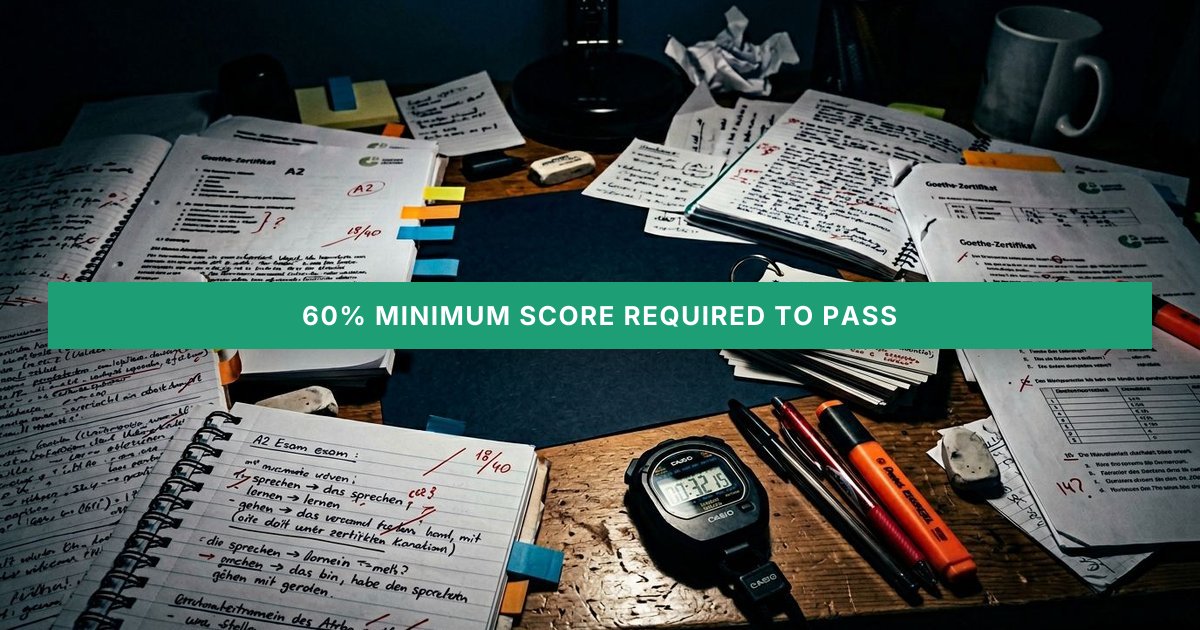
The Goethe-Zertifikat A2 requires candidates to achieve 60% of the maximum points in both the written exam and the oral exam to pass. This dual-threshold structure means you can't compensate for a weak speaking performance with strong reading scores—a reality that catches many learners off guard.
Case Study 1: University Student (8-Week Timeline, 168 Hours)
Background: 22-year-old economics student preparing for a semester abroad program in Munich. Previous German exposure: one semester of A1 coursework completed 6 months prior. Target exam: Goethe-Zertifikat A2, scheduled 8 weeks from start date.
Time Allocation Breakdown
| Exam Section | Hours Logged | Percentage of Total | Recommended % |
|---|---|---|---|
| Reading | 58 | 34.5% | 25% |
| Listening | 26 | 15.5% | 30% |
| Writing | 42 | 25% | 20% |
| Speaking | 22 | 13% | 25% |
| Grammar review | 20 | 12% | — |
The student front-loaded reading practice because textbook exercises felt "productive and measurable." Listening received the least attention until week 6, when the first full-length mock exam revealed a 48% listening score—below the 60% passing threshold.
Resources Used
- Menschen A2 textbook (Huber Verlag) + workbook: 52 hours
- Duolingo daily practice: 18 hours
- YouTube grammar videos (Easy German channel): 12 hours
- Private tutor sessions (1 hour weekly): 8 hours
- Mock exams from German Mock Exams's GOETHE-focused practice materials: 14 hours
- Tandem speaking partner (fellow student): 12 hours
Mock Test Progression
Week 4 (first full mock):
- Reading: 72/100
- Listening: 48/100
- Writing: 64/100
- Speaking: 58/100
- Written total: 61.3% (pass) | Oral: 58% (fail)
Week 6 (second mock):
- Reading: 78/100
- Listening: 62/100
- Writing: 68/100
- Speaking: 66/100
- Written total: 69.3% (pass) | Oral: 66% (pass)
Actual Exam Results:
- Reading: 74/100
- Listening: 58/100
- Writing: 70/100
- Speaking: 72/100
- Written total: 67.3% (pass) | Oral: 72% (pass)
Outcome: Passed, but listening score dropped 4 points from the second mock to the actual exam. The student later identified the culprit: mock test audio was replayed multiple times during practice, but the actual Goethe exam plays each listening passage only twice. Under real test conditions, the student missed critical details in Part 2 (understanding announcements) and Part 3 (everyday conversations).
Point-Losing Mistakes
- Listening Part 2 (announcements): Confused Gleis (platform) with Preis (price) in a train station announcement, selecting the wrong multiple-choice answer. Cost: 5 points.
- Writing Part 1 (form completion): Left the Geburtsdatum (date of birth) field in DD/MM/YYYY format instead of the required DD.MM.YYYY format with periods. Marked incorrect. Cost: 2 points.
- Speaking Part 2 (everyday situations): Used möchten (would like) correctly but failed to conjugate the verb in a follow-up sentence ("Ich möchten ein Ticket kaufen" instead of "Ich möchte"). Cost: 3 points for grammatical accuracy.
Recommendation for similar learners: Increase listening practice to 30% of total study time. Use realistic mock exams with audio files that enforce the two-playthrough rule from day one. Don't replay audio during timed practice—it creates false confidence.
Case Study 2: Working Expat (12-Week Timeline, 196 Hours)
Background: 34-year-old software developer relocating to Berlin for employment. No prior German study. Target exam: TELC A2 Deutsch, required for residence permit application. Studied while working full-time (40+ hours/week).
Time Allocation Breakdown
| Exam Section | Hours Logged | Percentage of Total | Recommended % |
|---|---|---|---|
| Reading | 44 | 22.4% | 25% |
| Listening | 62 | 31.6% | 30% |
| Writing | 38 | 19.4% | 20% |
| Speaking | 32 | 16.3% | 25% |
| Vocabulary drilling | 20 | 10.2% | — |
This learner prioritized listening early after reading that the TELC A2 Deutsch exam tests reading, listening, writing, and speaking skills according to CEFR A2 standards. The speaking allocation remained low due to difficulty scheduling conversation practice around work commitments.
Resources Used
- Schritte Plus Neu A2 (Huber Verlag): 58 hours
- Babbel app subscription: 34 hours
- iTalki online tutors (30-minute sessions, 2×/week): 24 hours
- Deutsche Welle Nicos Weg A2 course: 18 hours
- TELC sample tests from official website: 12 hours
- Mock exams from German Mock Exams's TELC-compatible materials: 16 hours
- Anki flashcard decks (A2 vocabulary): 20 hours
- Passive listening (podcasts during commute): 14 hours
Mock Test Progression
Week 5 (first full mock):
- Reading: 68/100
- Listening: 74/100
- Writing: 56/100
- Speaking: 52/100
- Written total: 66% (pass) | Oral: 52% (fail)
Week 9 (second mock):
- Reading: 76/100
- Listening: 78/100
- Writing: 64/100
- Speaking: 62/100
- Written total: 72.7% (pass) | Oral: 62% (pass)
Actual Exam Results:
- Reading: 78/100
- Listening: 76/100
- Writing: 62/100
- Speaking: 68/100
- Written total: 72% (pass) | Oral: 68% (pass)
Outcome: Passed comfortably. The speaking score improved 6 points from the second mock to the actual exam because the learner doubled speaking practice in the final three weeks, scheduling daily 15-minute iTalki sessions instead of twice-weekly 30-minute blocks. Shorter, more frequent sessions proved more effective for building fluency under time pressure.
Point-Losing Mistakes
- Writing Part 2 (short message/email): Used informal du instead of formal Sie when writing to a landlord about an apartment viewing. The TELC rubric penalizes register mismatch. Cost: 4 points for sociolinguistic appropriateness.
- Speaking Part 1 (introducing yourself): Mispronounced Beruf (profession) as "be-ROOF" instead of "be-ROOF" with a short u, causing the examiner to request clarification. Cost: 2 points for pronunciation clarity.
- Reading Part 3 (understanding signs/notices): Misread Ausgang (exit) as Eingang (entrance) on a building sign question. Cost: 3 points.
Recommendation for similar learners: If you're working full-time, daily 15-minute speaking drills outperform weekly hour-long sessions. Book iTalki tutors or language exchange partners for short, focused conversations. For writing, study the differences between TELC and GOETHE format expectations—TELC places heavier emphasis on sociolinguistic appropriateness (formal vs. informal register).
Case Study 3: Retiree (16-Week Timeline, 224 Hours)
Background: 67-year-old retiree preparing to join family in Stuttgart. Previous language learning: high school French 40+ years ago. Target exam: Goethe-Zertifikat A2. No time constraints, self-paced study.
Time Allocation Breakdown
| Exam Section | Hours Logged | Percentage of Total | Recommended % |
|---|---|---|---|
| Reading | 72 | 32.1% | 25% |
| Listening | 48 | 21.4% | 30% |
| Writing | 58 | 25.9% | 20% |
| Speaking | 28 | 12.5% | 25% |
| Grammar exercises | 18 | 8% | — |
This learner heavily favored reading and writing because "I can work at my own pace and check my answers." Speaking practice was avoided until week 10 due to anxiety about making mistakes in front of others.
Resources Used
- Begegnungen A2+ textbook: 68 hours
- Rosetta Stone German subscription: 42 hours
- Local community college evening class (2 hours/week): 32 hours
- Private tutor (1.5 hours weekly): 24 hours
- Official Goethe-Institut practice materials: 16 hours
- Mock exams from German Mock Exams's comprehensive A2 practice sets: 18 hours
- Language exchange meetup group: 12 hours
- Self-study grammar workbook: 12 hours
Mock Test Progression
Week 6 (first full mock):
- Reading: 82/100
- Listening: 54/100
- Writing: 76/100
- Speaking: 44/100
- Written total: 70.7% (pass) | Oral: 44% (fail)
Week 12 (second mock):
- Reading: 84/100
- Listening: 64/100
- Writing: 78/100
- Speaking: 58/100
- Written total: 75.3% (pass) | Oral: 58% (fail—just below 60% threshold)
Actual Exam Results (first attempt):
- Reading: 86/100
- Listening: 62/100
- Writing: 80/100
- Speaking: 56/100
- Written total: 76% (pass) | Oral: 56% (fail)
Outcome: Failed first attempt due to speaking score. Retook the oral exam 6 weeks later after intensive speaking practice (48 additional hours focused solely on Part 2 and Part 3 of the speaking test). Second attempt speaking score: 72/100. Passed overall.
Point-Losing Mistakes (First Attempt)
- Speaking Part 2 (making requests): Froze when asked to request a train ticket and defaulted to English phrase structure: "Ich brauche ein Ticket nach München für morgen" (grammatically acceptable) but failed to add polite framing like "Ich hätte gern" or "Könnte ich bitte," which the rubric rewards. Cost: 6 points for task completion and sociolinguistic competence.
- Speaking Part 3 (negotiating solutions): Couldn't produce the conditional form könnte (could) when suggesting an alternative meeting time, instead saying "Ich kann vielleicht Donnerstag" (I can maybe Thursday). Cost: 5 points for range of language.
- Listening Part 4 (phone messages): Missed the callback number in a voicemail because the speaker said digits in pairs ("drei-und-zwanzig" for 23) rather than individually. Cost: 4 points.
Recommendation for similar learners: Start speaking practice in week 1, not week 10. Anxiety compounds when you delay. Use the overcoming A1 hurdles strategies to build confidence with low-stakes practice before attempting full speaking mocks. Record yourself completing speaking tasks and compare your responses to model answers—self-assessment accelerates improvement when in-person practice feels intimidating.
Common Patterns Across All Three Cases
All three learners logged between 168–224 hours of preparation, aligning with the typical 180–200 hour benchmark for A2 readiness. Yet their initial mock scores revealed the same structural flaw: disproportionate time allocation that favored reading and writing over listening and speaking.
The 25-30-20-25 Rule
Based on these cases and the Goethe-Zertifikat A2 exam structure—which allocates 30 minutes each to reading, listening, and writing, plus 15 minutes for speaking—I recommend this time distribution for your total study hours:
- Reading: 25% (enough to handle authentic texts like ads, emails, signs)
- Listening: 30% (the section where most candidates lose points due to under-practice)
- Writing: 20% (structured tasks with clear rubrics; easier to self-correct)
- Speaking: 25% (cannot be crammed; requires consistent practice to build fluency)
All three learners who deviated from this allocation—especially those who short
Leave a comment